Billi Media
What to Consider When Specifying a Water System
A workplace water system can influence more than the choice of dispenser on the benchtop. Its capacity, underbench footprint, cooling method and servicing requirements can affect cabinetry, building services and how well a shared hydration point performs during periods of peak demand.
These considerations make water-system specification an important part of workplace breakout space design. With more than 30 years’ experience in instant filtered water systems, we have developed commercial solutions around specification challenges including space-saving underbench design, water-cooled technology, heat exchange and energy reclaim.
For architects, interior designers, engineers, workplace consultants and facility teams, learn how to assess the system against the needs of the project. Demand, available space, heat, noise, ventilation, accessibility, energy use, maintenance and sustainability credentials all deserve consideration before the specification and surrounding joinery are finalised.
Treat the hydration point as part of workplace design
A hydration point operates within a wider network of movement and activity. People may approach it between meetings, during concentrated break periods or while others are preparing food and using nearby appliances. Its position therefore needs to make sense within the circulation and function of the office breakout space.
Consider the relationship between the dispenser, sink, food preparation areas and other appliances. Think about how people will approach and leave the area, whether several users can move through it comfortably and how the hydration point interacts with the rest of the workplace kitchen design.
There is another layer beneath the benchtop. The system needs to coexist with plumbing, waste, storage and other services. Good coordination allows the visible dispenser and underbench equipment to be resolved together, rather than forcing the water system into whatever cupboard space remains once the joinery has been designed.
Dispenser selection can also form part of the project’s wider accessibility planning. We offer a range of commercial dispenser options, including the XL Levered dispenser with red and blue coloured levers and braille pads for vision-impaired applications. The suitability of any dispenser should still be assessed against the accessibility requirements of the individual project.
Calculate demand before choosing equipment
A compact office kitchenette might serve a large workforce. A larger breakout space may experience relatively dispersed demand. What matters is how people will use the hydration point, particularly when demand is concentrated.
At the briefing stage, establish:
- The number of people expected to use each hydration point
- Likely periods of peak demand
- The water options required
- Initial boiling-water requirements
- Recovery requirements
- Chilled-water requirements
- Whether sparkling water is required.
Depending on the system selected, our commercial range can provide combinations of boiling, chilled, sparkling and ambient filtered drinking water.
Headcount is useful, but it should not become an arbitrary employee-to-system formula. Meeting patterns, break times and the distribution of hydration points across a workplace can all change the load placed on individual systems.
Exact capacity, initial output and recovery requirements should be checked against current technical information for the system being considered. That is particularly important on larger projects, where several hydration points may serve different zones or occupancy patterns.
Protect valuable underbench space
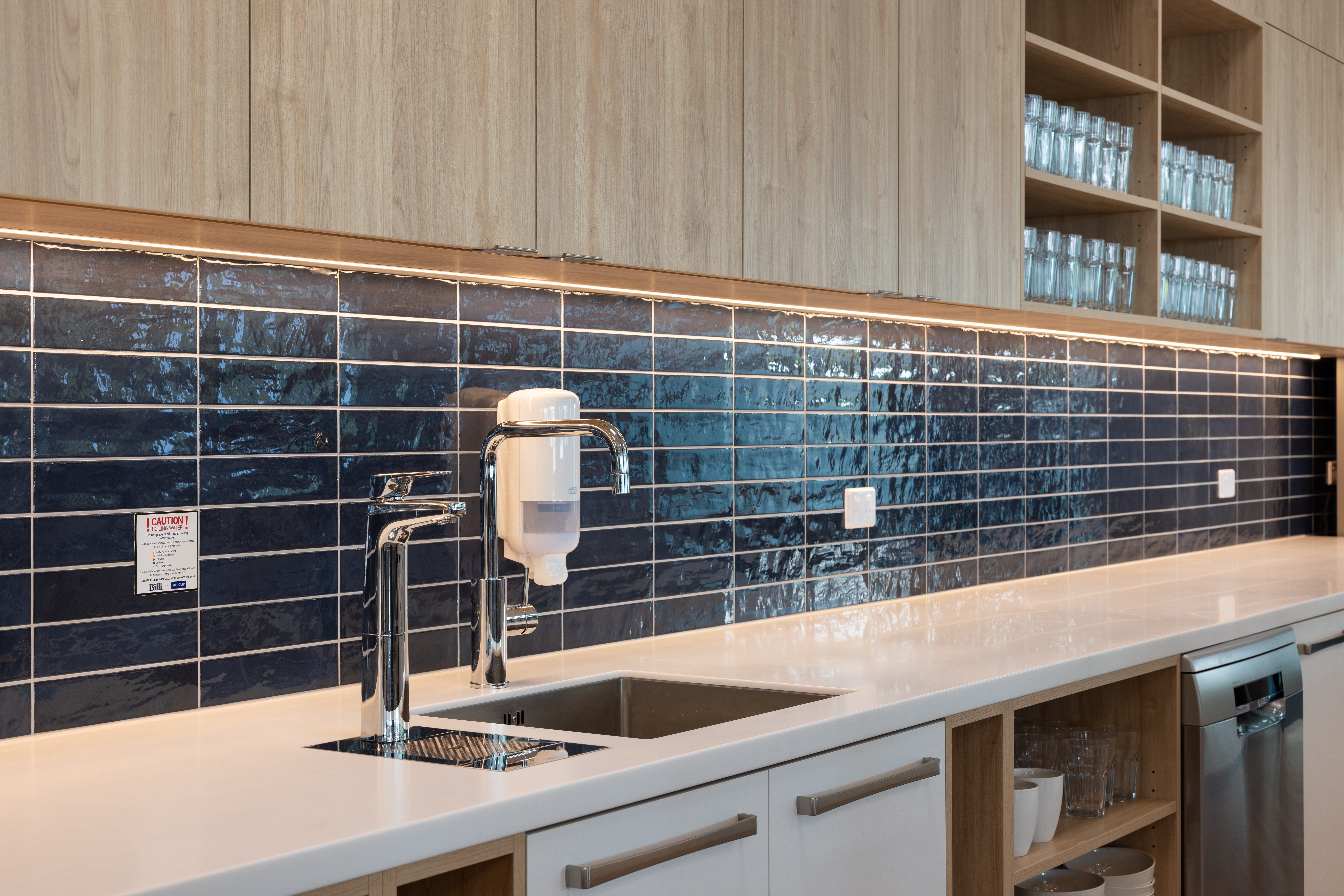
Once the required functions and capacity are understood, the physical implications become clearer. Underbench space is limited. Plumbing and waste already occupy part of the cabinet, while workplace kitchen designs may also need storage and other equipment or services. A large equipment footprint can reduce the flexibility available to the joinery designer.
Our commercial systems are designed around space-saving underbench footprints. The practical benefit is not just a smaller appliance, but preserving usable cupboard space to coordinate the water system with the other elements that need to sit beneath the benchtop.
Exact dimensions still matter. They should be checked for the selected model alongside installation and service-access requirements before cabinetry is finalised.
For a closer look at the spatial considerations around filtration equipment, read benchtop vs underbench water filters for your office sink.
Consider how cooling technology affects the space
How a system is cooled can influence the surrounding joinery, acoustics and thermal conditions as well. This is why our systems use heat exchange and energy reclaim technology and do not require cooling fans or cupboard ventilation. They also operate more quietly than air-cooled systems.
Removing the need for a cooling fan eliminates fan-related noise. Removing the need for cupboard ventilation can also simplify joinery because ventilation cut-outs are not required. This can be useful in tightly planned office breakout spaces where cabinetry, services and storage all compete for limited space.
Therefore, the useful specification question is what that cooling method means for the surrounding space and the building services supporting it.
Look at how the system uses energy
As discussed, our systems use heat exchange and energy reclaim technology. Heat generated through the chilling process is recovered and used to assist in preheating the boiling-water supply. Energy that would otherwise leave the chilling process as waste heat is therefore reused within the system.
Selected Billi systems also include additional energy-management features. Billi Eco and Sahara systems use Eco-Intelligence technology, a self-learning timer that monitors usage patterns so the unit operates when required. These systems feature standby functionality that reduces operation during periods of non-use.
For specifiers, the value lies in understanding how the equipment consumes and manages energy rather than relying on broad environmental claims. Review which energy-management functions apply to the particular model, how the cooling technology operates and whether those characteristics suit the wider project requirements.
Learn more about achieving energy efficiency in buildings with Billi.
Design for accessibility and safe use
Accessibility requirements vary between workplaces, making dispenser selection worth considering early. Our XL Levered dispenser is one example of a configuration developed for particular user requirements, with red and blue coloured levers and braille pads for vision-impaired applications.
Boiling water introduces a separate safety consideration. Our dispensers offering boiling water are supplied with a safety switch that can lock access to boiling water where required. Our splashfree delivery also electronically varies the water flow, slowing momentarily as boiling water first enters the cup.
These are product features that specifiers should establish the applicable accessibility and safety requirements for the workplace, then select and configure equipment accordingly.
Plan servicing before the joinery is finalised
Instant filtered drinking-water systems require maintenance and filter replacement to support ongoing water quality and system performance. That makes service access a practical design consideration, not simply an operational issue for later.
Before cabinetry is signed off, consider whether the unit and its filters can be accessed without unnecessarily disrupting surrounding joinery. The person servicing the equipment needs workable access.
The project team should also establish how maintenance will be managed during the system’s working life. Depending on the service arrangement selected, we can offer preventative maintenance, genuine filters and parts and manufacturer-supported servicing.
For facility managers, this is important because a system may be straightforward to install yet awkward to maintain if service access was not considered during design.
Learn more about our customer care services.
Compare whole-life requirements rather than the dispenser alone
Consider what different systems require throughout their working life. Depending on the application, that may include:
- equipment and installation requirements
- electricity and water use
- filter replacement
- scheduled servicing
- maintenance access
- CO? requirements where sparkling water is specified
- expected peak demand
- operational requirements during maintenance.
Whole-life assessment is particularly useful for commercial developers and facility managers because it shifts the comparison beyond appearance or initial equipment requirements. It creates a basis for how the system will be installed, operated and maintained over time.
Bring water system specification into the project early
For architects, interior designers, engineers, workplace consultants and facility teams, there is value in bringing hydration into the specification process early. Contact our team for specification support.