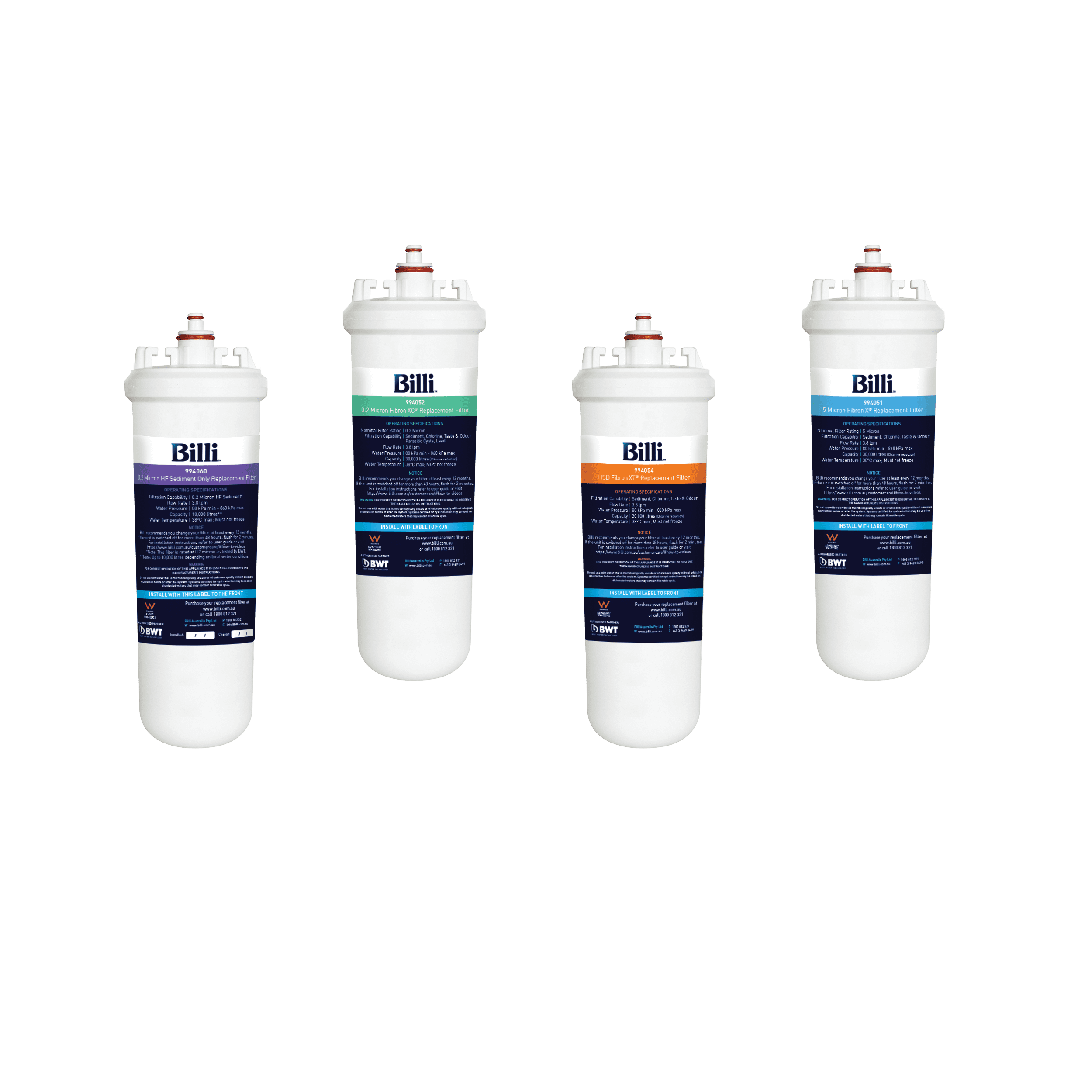
Billi Media
What Makes Billi Filters Different? Fibron X Technology
Many homeowners assume that once a filter contains carbon, the job is done. If it reduces chlorine and improves taste, that feels sufficient. Yet the performance of a water filter depends not only on what it is made from, but also on how it is constructed. The structure of the media, the density of its layers and the way water moves through it all influence how consistently it performs over time.
For more than 30 years, Billi has been designing and manufacturing instant filtered boiling and chilled water systems in Australia. Our filtration range incorporates Fibron X activated carbon fibre technology in partnership with BWT, Europe’s largest water treatment products company. The focus is on engineered performance, supported by specifications and independent testing.
Understanding that distinction changes how you evaluate a filter. It shifts the conversation from “carbon vs no carbon” to how that carbon is designed to work.
Why Water Filtration Quality Matters
New Zealand’s municipal water supplies are treated to be safe. However, that does not mean they are optimised for taste.
Chlorine residuals can influence flavour. Organic compounds may affect odour. Sediment levels can vary depending on infrastructure and local conditions. These differences are often subtle, yet noticeable in tea, coffee and sparkling water.
If you are investing in a premium underbench system, the quality of the filtration media determines how effectively those elements are reduced and how consistently that performance is maintained.
Not All Carbon Filters Are Engineered the Same
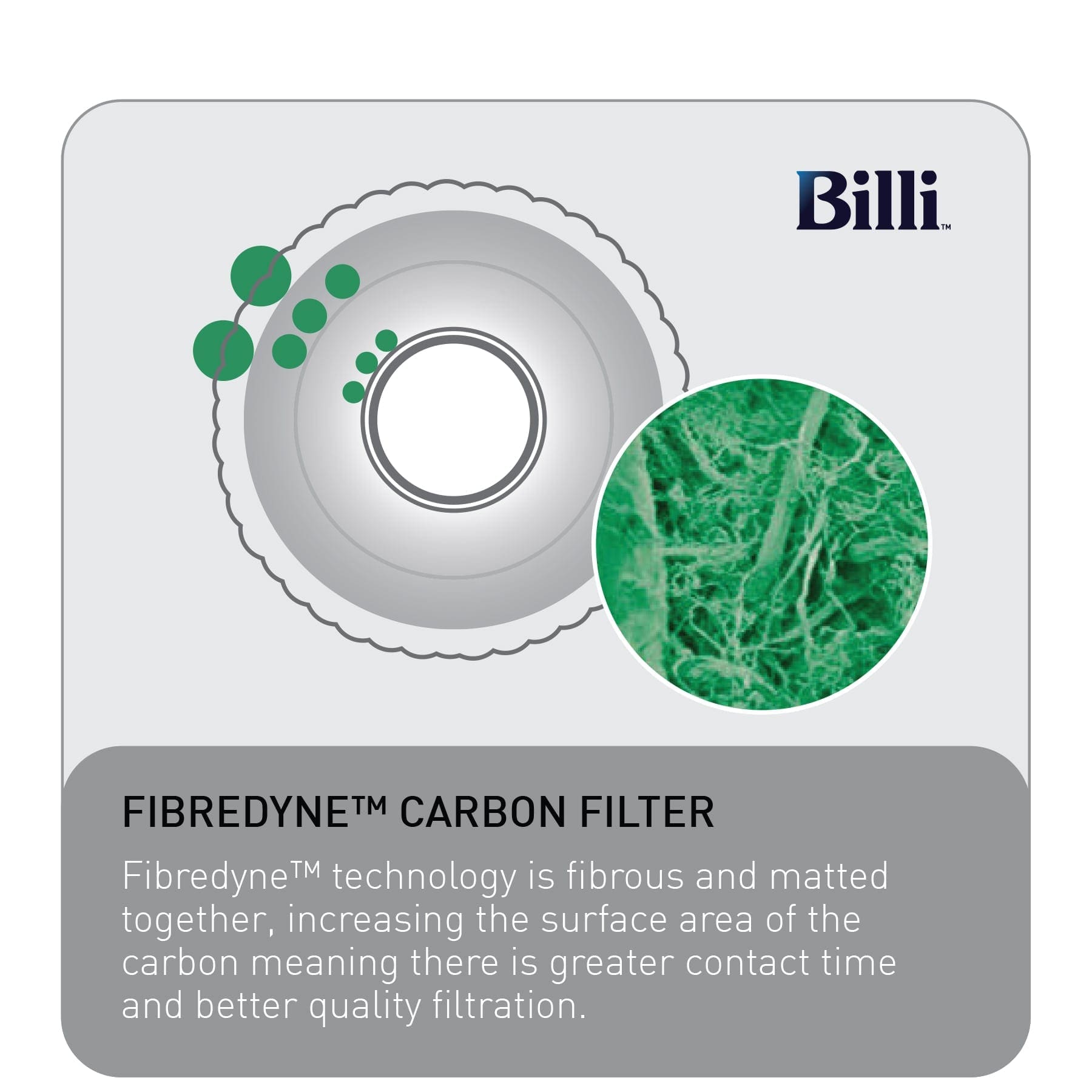
Traditional carbon filters are commonly made from granulated carbon. Those granules are often bonded with a resin. While effective, this structure reduces available surface area within the filter, and surface area matters.
Adsorption takes place across the carbon surface, so the more usable surface available, the greater the opportunity for chlorine and certain organic compounds to be reduced. This does not mean conventional filters perform poorly, but the internal structure of the media influences capacity and consistency over time.
How Fibron X Activated Carbon Fibre Technology Works
Our premium filters utilise BWT’s Fibron X technology. Instead of loose granules, Fibron X uses activated carbon fibre with minimal bonding agent arranged in a graded density profile.
This design is intended to provide:
- High levels of filtration for chlorine, sediment, chemical taste and odour reduction
- Consistent performance across the rated filter capacity
- Controlled flow suited to underbench systems
In the 0.2 micron Fibron XC filters, the graded density structure is designed to support cyst reduction with low pressure drop as specified.
The 5 micron Fibron X filters, the 0.2 micron Fibron XC filters, and the HSD Fibron XT filters are each rated at 30,000 litres for chlorine reduction, with a nominal flow rate of 3.8 litres per minute.
What Billi Filters Are Designed to Reduce
Each filter in our range has a specific, published capability.
- 5 Micron Fibron X Replacement Filter: Designed to reduce sediment, chlorine, taste and odour. Rated at 30,000 litres for chlorine reduction.
- 0.2 Micron Fibron XC Replacement Filter: Designed to reduce sediment, chlorine, taste and odour, and parasitic cysts, including giardia and cryptosporidium. Rated at 30,000 litres for chlorine reduction.
- HSD Fibron XT Replacement Filter: Designed for higher sediment environments while maintaining reduction of sediment, chlorine, taste and odour. Rated at 30,000 litres for chlorine reduction.
- Sediment Only Replacement Filter: Designed for particulate reduction only.
Selecting between these options depends on your water supply and the level of filtration you prefer. Understanding water quality testing and maintenance can help clarify the considerations involved.
Understanding 0.2 Micron and 5 Micron Ratings
Micron ratings are often misunderstood. A micron refers to the nominal size of particles the filter is designed to target. Within our filter range:
- 5 micron filters support sediment reduction and chlorine, taste and odour improvement.
- 0.2 micron filters provide finer filtration and include cyst reduction capability.
Finer filtration does not automatically mean restricted flow. As mentioned, the filters are rated at 3.8 litres per minute, and our systems are engineered around these parameters.
Certified and Independently Tested Performance
Our filters have been independently tested and certified by IAPMO to international standards and the Australian Watermark. Filter performance testing is conducted in accordance with NSF, WRAS and Watermark standards.
Beyond filtration, our designs and manufacturing of boiling and chilled systems are to strict quality standards. We hold ISO 9001, ISO 14001 and ISO 45001 certifications and Quadra units have been repeatedly certified by Global GreenTag. We also maintain a Cornerstone Membership with the International WELL Building Institute.
These credentials provide confidence that the Billi system beneath your bench has been developed within a robust quality and environmental framework.
Everyday Benefits You Will Notice
Reducing chlorine can improve the clarity and flavour of tea and coffee. Sparkling water tastes cleaner when unwanted odours are reduced at source. Cooking with filtered water removes the faint chemical edge that can affect delicate dishes.
An integrated underbench system also provides a continuous supply of filtered water without the clutter of jugs or countertop devices. It can reduce reliance on bottled water and support efforts to eliminate single-use plastics in the home.
Individually these benefits may seem small. Over time, they shape the overall experience of your kitchen.
In areas with harder water conditions, such as parts of WA, NT and QLD, incorporating prefiltration can also help support system performance and longevity by reducing particulate build-up before water enters the main filtration system. Solutions such as the Billi HSD Pre-Filter Kit are designed for this purpose.
When to Replace Your Filter and Why It Matters
All filters have a defined capacity. Once that capacity is reached, adsorption performance gradually declines.
We recommend replacing filters at least every 12 months. In higher usage environments or specific water conditions, replacement every 6 months may be appropriate.
The Billi filter replacement process is designed for simplicity. Amber dispenser icons indicate when replacement is due. The swing change design allows the cartridge to move forward and slide out. Genuine Billi filters include a digital lockout feature to retain single use integrity and support hygiene.
If you want professional servicing, maintaining your filtration system with BilliCare is an option.
Learn More About Carbon Filtration
Once you examine how a filter is built, the differences become clearer. Carbon is not a uniform category, as structure influences surface area, surface area influences adsorption, and testing validates performance.
Fibron X activated carbon fibre technology is supported by defined micron ratings, published capacities and independent certification. Combined with clear replacement guidance and integrated system design, Billi filters provide verifiable filtration performance.
Learn more about our range of instant filtered water systems to confirm which specification suits your environment, or visit your local stockist for advice.