Billi Media
Specifying Home Water Filtration Systems
It’s easy to assume that our drinking water is already as good as it gets. After all, New Zealand’s water supplies are treated and regularly monitored (Water Services Authority Taumata Arowai). But many homes, especially those with older plumbing or rainwater tanks, still experience taste issues, lingering chlorine odours, or a build-up of fine particles in taps and kettles.
Water filtration at home does more than just make your water look clearer. It helps remove particles you can’t see, improves flavour, and reduces exposure to chemicals or microbes like Giardia and Cryptosporidium (ScienceDirect). Even in treated urban water, chlorine and other by-products can impact how your water tastes and smells.
Investing in a good filtration system doesn’t just protect your health, it elevates everyday convenience and confidence, turning every glass of water into something you can enjoy without second guessing.
Understanding filtration types and micron ratings
Choosing a water filter means understanding what it actually removes. The main indicator is the filter’s micron rating, a measure of how small the particles are that the filter can trap.
Micron ratings:
- 5 micron – Removes larger, visible particles like rust
- 2 micron – Filters finer particles, chlorine, cysts like Giardia, and some heavy metals
- 0.2 micron – Delivers another level of filtration, removing microscopic contaminants
Filter types to consider:
- Particle filters remove physical debris and are often the first stage of filtration
- Activated carbon filters absorb chlorine, organic compounds, and improve taste and smell
- Reverse osmosis systems use a membrane to eliminate a wide range of contaminants, though these are more common in commercial settings
- UV purification is suitable for untreated sources like rainwater, neutralising bacteria and viruses
Billi’s advanced Fibron X filtration offers a major performance advantage. Its carbon fibre structure provides a larger surface area and graded density, meaning water is filtered thoroughly across multiple layers, not just in one path. Cheaper filters can allow water to “track” through a single channel, reducing effectiveness over time.

What to consider before choosing your system
No two homes have the same water needs. The right filtration solution depends on how your household uses water, what’s in your supply, and how much maintenance you’re willing to manage. Here’s what to keep in mind:
- Your daily water usage: Larger families, or homes that use boiling, chilled or sparkling water systems regularly, need higher capacity filters.
- Water source and quality: City water is chlorinated and safe, but it can carry by-products or metals from pipes. Rainwater systems may require UV and fine-micron filters for microbial protection.
- Space and layout: Underbench systems like Billi’s are compact and require no cupboard ventilation, making them ideal for most kitchens.
- Upfront and long-term costs: Look beyond initial price. Higher-quality filters often last longer and perform better, meaning fewer replacements and better value over time.
- Accredited certifications: Always check that your system meets recognised standards. Billi filters are certified by WaterMark, NSF, IAPMO, and WRAS, confirming their claims are backed by independent testing.
Why Billi systems deliver reliable filtration and peace of mind
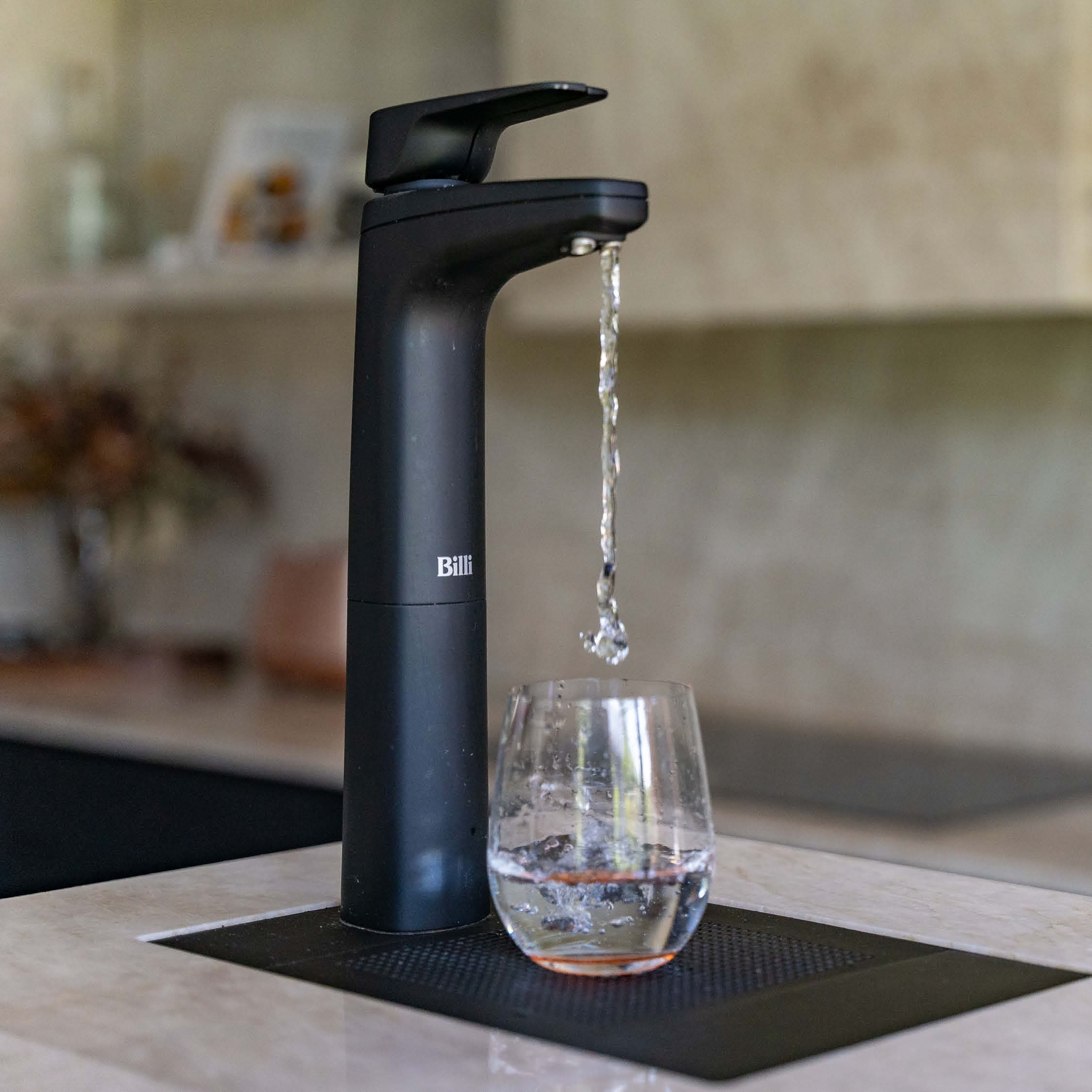
Backed by over 30 years of experience, Billi’s systems are designed not just to meet expectations but to exceed them, both in performance and user experience.
The Fibron X filter media used in all Billi residential systems delivers a high surface area and minimal bonding agents, reducing chlorine, odour, organic chemicals, and particles while letting minerals through to maintain taste.
The 0.2-micron filter (994052) is Billi’s highest-grade option, capable of removing parasitic cysts, and microscopic contaminants.
The 5-micron filter is for households simply wanting to improve taste, smell, and reduce limescale.
Every Billi system is independently certified and complies with international standards, including:
- NSF (National Sanitation Foundation)
- WaterMark (Australia/NZ standard)
- IAPMO and WRAS (UK)
In terms of functionality, Billi’s underbench models require minimal space, use energy-efficient heat exchange systems, and are available with options for boiling, chilled, and sparkling water. Maintenance is straightforward, with swing-change filters and optional digital alerts to notify you when replacement is due.
Common concerns answered
Isn’t NZ water already safe to drink?
Yes, but filtration improves more than safety. It enhances taste, reduces chlorine and particles, and offers peace of mind if your plumbing is old or your source is rain-fed.
Aren’t good systems expensive?
Billi systems are built to last and perform reliably. Compared to bottled water or frequent filter changes in cheaper units, Billi’s premium systems often provide better long-term value.
Will it be complicated to install or maintain?
Not at all. Billi’s underbench units are compact and designed for quick installation. Filters typically need changing every 6 to 12 months, but filter changes are simple and stress-free.
How do I know which model I need?
We’ve made that easy, use our specification tool or speak with our expert team to match a system to your water type, kitchen space and lifestyle.
Finding your fit with Billi
For everyday taste and odour issues, a 5-micron filter may be all you need. If you’re drawing from untreated sources, or want protection from heavy metals and microbes, the 0.2-micron option is the highest-grade residential solution Billi offers. And if convenience matters, features like digital alerts help you stay in control without stress.
Ready to get started? Explore our home filtration systems to find your ideal match.