Billi Media
Billi vs Traditional Kettles: Cost and Energy Comparison
Most of us boil water without much thought. A cup of tea, a quick coffee, dinner prep. You fill the kettle, wait for it to boil, pour what you need, then repeat the process later when the water has cooled or someone else has used it. It’s familiar, functional, and easy to overlook.
Yet boiling water is one of those small, repeated actions that quietly shapes how a kitchen or office works. Time spent waiting, energy used reheating water, benchtop space taken up by appliances, and the way boiling water is handled add up over weeks and years. When something is used this often, the design behind it matters.
When comparing the traditional electric kettle and a Billi instant boiling water system, rather than focusing only on upfront cost, consider the long-term ownership, everyday energy use, safety, convenience, and environmental considerations.
Upfront cost vs long-term ownership
A Billi system represents a higher upfront investment. It is a fixed appliance designed to be installed under the bench and supported through ongoing care, including periodic filter replacement to maintain water quality. We recommend replacing filters at least every 12 months as a minimum, with shorter intervals in some higher-use environments.
The comparison shifts when you look beyond the first transaction. Kettles are commonly treated as short to medium-term appliances. When performance drops, scale builds up, or the unit fails, replacement is often the default response. A Billi system, by contrast, is designed as a long-term fixture, supported by manufacturer servicing and genuine replacement components.
For people already considering broader efficiency upgrades, this way of thinking often aligns with other decisions around the home. It’s the same mindset explored in energy-saving appliances for eco-conscious Kiwi homes, which looks at how long-term value is created through better-designed systems rather than short-term savings.
How energy use differs in real life
Energy comparisons are often reduced to numbers, but everyday behaviour plays a large role in how much electricity is actually used.
With kettles, a few common habits influence energy use:
- Overfilling: Many people boil more water than they need, just in case.
- Reboiling: Water cools quickly, so the kettle is often switched on again later for a single cup.
- Batch heating: Kettles are designed to heat a volume, even when only a small amount is required.
An instant boiling water system works differently. The focus is on delivering boiling water when it’s needed, without repeatedly heating surplus water. Billi supports this approach with specific design features intended to manage energy more efficiently.
In systems that include chilling, waste heat produced during the chilling process is recovered and used to preheat boiling water. This heat exchange and energy reclaim technology helps boiling water reach temperature more efficiently while supporting overall energy savings within the system.
Billi systems also include energy management features such as a standby mode that powers the unit down after two hours of non-use. Certain models incorporate Eco-Intelligence technology, a self-learning timer that monitors usage patterns and adjusts operation so the system runs primarily when it’s needed.
Rather than promising a fixed outcome, these features are designed to respond to how kitchens and offices are used, with busy periods followed by quieter stretches. For a broader view of this design philosophy, achieving energy efficiency in buildings with Billi provides additional context.
Speed and convenience in busy kitchens and small offices
A kettle requires waiting for each boil cycle. In a quiet household this may feel insignificant. In a family kitchen during the morning rush, or a small office where several people prepare hot drinks around the same time, those waits add up. Kettles are switched on, checked, reboiled, and sometimes forgotten.
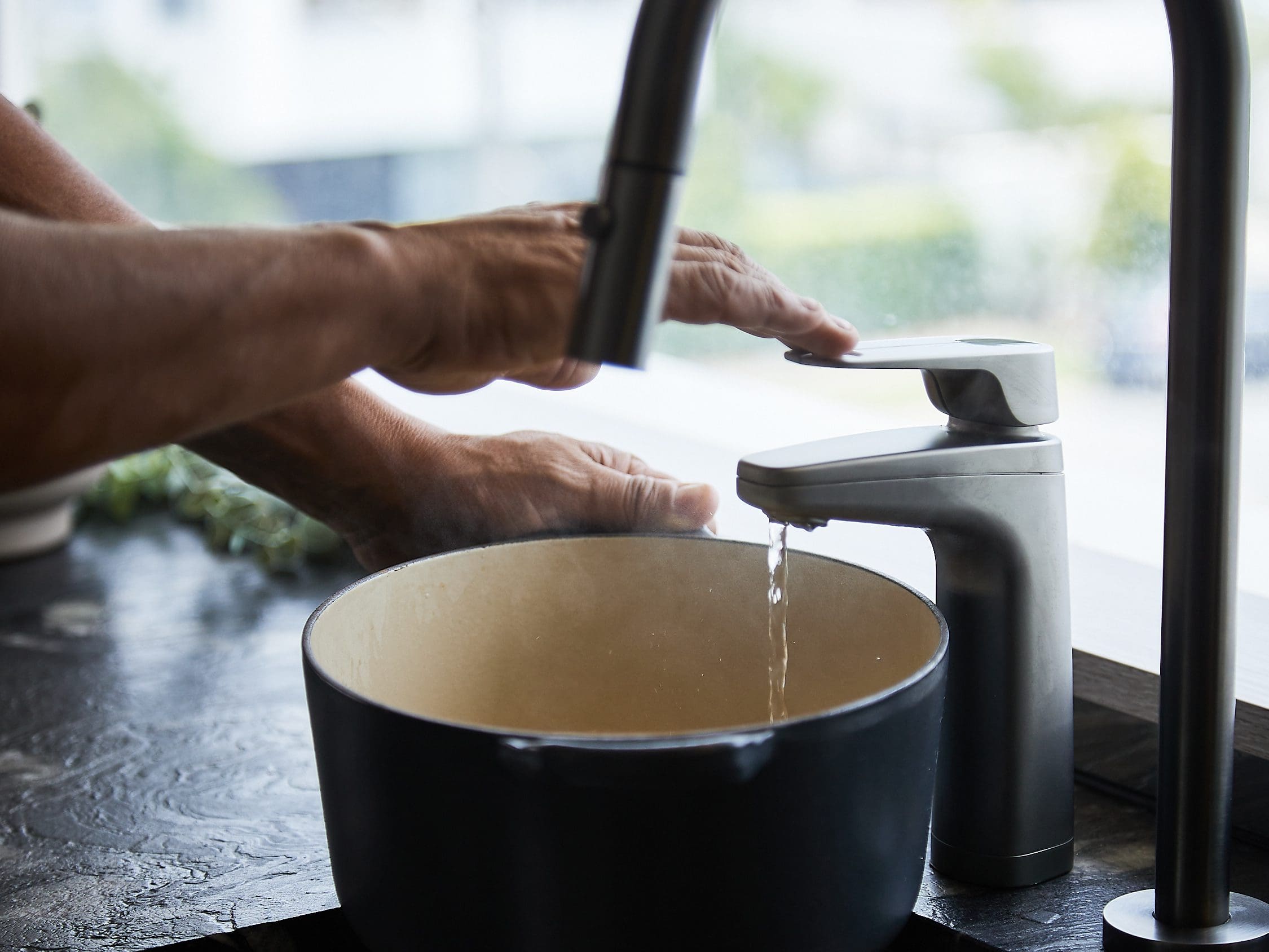
With a Billi system, boiling water is available immediately at the tap. The workflow changes. Drinks are made without delay, and the stop-start rhythm associated with kettle use largely disappears. The underbench design can also free up benchtop space, reducing clutter from permanent appliances.
In workplace settings, these small improvements can have a noticeable impact on how shared kitchenettes feel and function. Read Boiling water taps for your office to explore this in detail.
Safety differences people often overlook
Boiling water carries inherent risks, and most kettle users have experienced at least one close call. Spills, steam burns, unstable cords, or crowded benches can all contribute to accidents, particularly in shared or fast-paced environments.
Billi boiling water dispensers are supplied with a safety switch that can lock access to boiling water. When safety mode is active, boiling water cannot be dispensed until the user intentionally unlocks it. After a period of non-use, the dispenser automatically returns to safety mode.
Another practical feature is splash-free boiling water delivery. The system varies the flow electronically, slowing briefly as water first enters the cup to help reduce splashing. It’s a small adjustment, but one designed around real-world use rather than ideal conditions.
These features don’t remove the need for care, but they shift some responsibility for safety into the design of the appliance itself. For households with children, or workplaces with many users, that added layer can be important.
Environmental impact over the life of the appliance
Small appliances such as kettles are often discarded rather than repaired. Over time, this pattern contributes to unnecessary appliance waste, even if each individual unit seems minor on its own. While a kettle may only last a few years, a Billi system is engineered for longevity, with an expected lifespan of up to 10 years when properly maintained.
Billi takes a considered approach to sustainability through thoughtful product design and independent third-party certification. We have been certified and re-certified by Global GreenTag since 2012 at the Gold level under the LCARate™ program and hold an Environmental Product Declaration in accordance with EPD EN 15804.
Our water-cooled systems are designed to deliver measurable environmental benefits, with a lower and verifiable carbon footprint across the life of the appliance.
When a traditional kettle is still the better fit
A kettle remains a sensible choice in many situations. It may suit you if:
- Boiling water is used only occasionally
- You want a portable, low-commitment option
- Your current layout makes an underbench system impractical
When a Billi system makes more sense
A Billi instant boiling water system tends to be most effective where boiling water is part of the daily routine rather than an occasional task.
It may be the more practical option if:
- Boiling water is used several times a day, often by more than one person
- You want immediate access without repeated boil-and-wait cycles
- Built-in safety controls are important in your environment
- You prefer a cleaner bench and a more integrated kitchen or kitchenette
- You value energy management features such as heat exchange, standby mode, and in some systems Eco-Intelligence scheduling
Make a decision based on usage, not habit
To explore whether a Billi system suits your home or workplace, you can learn more by viewing the full product range, or find a stockist to take the next step.