Billi Media
Specifying Instant Filtered Water Systems for Commercial Projects
Specifying water systems for commercial buildings is a design decision that affects performance, efficiency, and long-term usability. It influences how a space operates day to day, how easily it can be constructed, and how well it supports occupants.
In many projects, water systems are addressed late in the design process. By that stage, space allocation is fixed, services are constrained, and options become limited. The result is often a compromise rather than a considered solution. As sustainability targets become more defined and workplace expectations continue to evolve, this approach is no longer sufficient. Water systems now need to be integrated into early-stage planning alongside layout, energy strategy, and user experience.
With more than 30 years of experience designing and manufacturing instant filtered water systems, Billi has developed solutions that respond directly to these challenges. The focus is to reduce complexity, improve performance, and simplify specification.
Why water system specification matters in commercial buildings
Water systems are used continuously across commercial environments. Staff kitchens, breakout areas, hospitality zones, and shared facilities all rely on consistent access to boiling and chilled water. When systems are poorly specified, the impact is immediate. Delays in use, inefficient workflows, and reliance on multiple appliances.
A well-specified system supports daily operations. It reduces dependency on separate equipment, integrates into the built environment, and contributes to overall building performance. Energy use, maintenance planning, and sustainability outcomes are all influenced by this decision.
Criteria for specifying a commercial water system
Effective specification begins with a clear framework. The following factors should be assessed early:
- Number of users and peak demand periods
- Required water types including boiling, chilled, sparkling or ambient
- Available underbench space
- Power supply and plumbing access
- Joinery and installation constraints
- Energy performance targets
- Sustainability frameworks such as WELL or Green Star
- Maintenance access and filter replacement requirements
Billi systems are designed to suit a wide range of usage scenarios, with model selection guided by user numbers and output capacity.
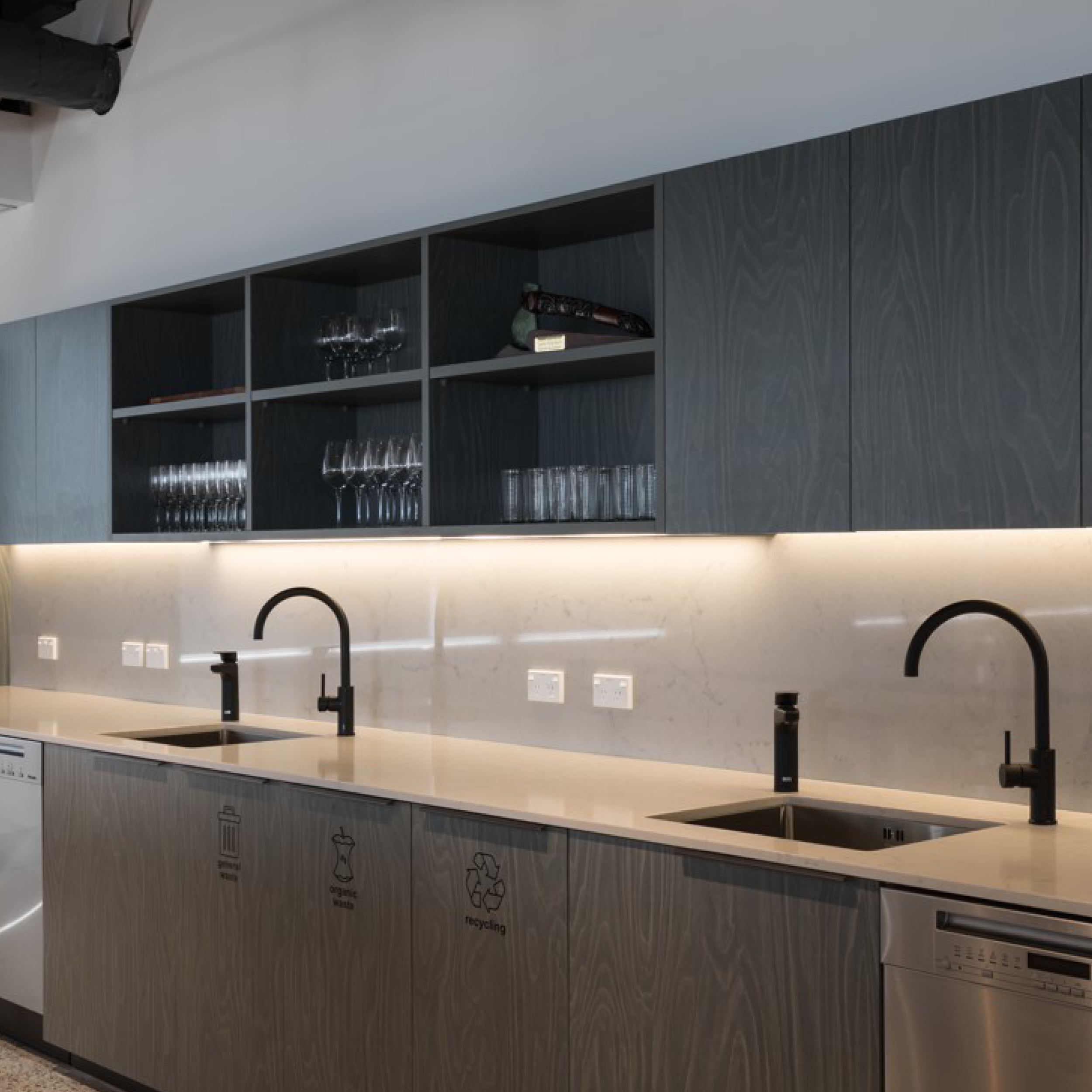
Space-saving underbench design for commercial fit-outs
Space within commercial joinery is limited and highly contested. Underbench systems address this constraint directly. Billi systems are designed with compact footprints, using up to 65% less cupboard space than comparable alternatives. This enables more efficient use of cabinetry and reduces the need for multiple appliances. A single system can replace kettles, chillers, and separate filtration units. The result is a cleaner layout, improved usability, and greater design flexibility. This allows designers to retain storage, maintain clear surfaces, and simplify planning.
Water-cooled vs air-cooled systems in commercial projects
The choice between water-cooled and air-cooled systems is a critical technical decision in commercial specification. Billi offers both, but the performance characteristics differ significantly.
| Specification factor | Water-cooled systems | Air-cooled systems |
| Energy efficiency | Higher efficiency through heat exchange | Lower relative efficiency |
| Heat output | Minimal heat transfer to cabinetry | Greater ambient heat |
| Ventilation | No ventilation required | May require airflow planning |
| Noise | Quiet operation | Higher operational noise |
| Installation | Simplified | May require additional allowances |
| Application | High-performance commercial environments | Lower constraint environments |
Removing ventilation requirements from the specification
The engineering behind water-cooled systems leads directly to a key specification benefit. Ventilation is no longer required. Billi water-cooled units do not require cupboard ventilation, cooling fans, or joinery cut-outs. This simplifies installation and reduces coordination between trades. Joinery can be designed without allowances for airflow, and installation can proceed without additional modifications. The outcome is a cleaner, more predictable build process.
Supporting sustainable building outcomes
Sustainability is now embedded in commercial design requirements. Water systems must contribute to measurable outcomes rather than general intent. Billi systems support this through:
- Heat exchange technology that reuses waste heat to reduce overall energy demand
- Water-cooled operation that improves efficiency
- Global GreenTag certification at a recognised level
- Environmental Product Declarations under EPD EN 15804
- Alignment with Green Star (Quadra units only), LEED, and WELL frameworks
These credentials provide verifiable support for compliance and reporting. Learn more about our sustainability commitments.
Filtration performance and correct specification
Filtration must be specified accurately. General claims are not sufficient in a commercial context. Billi systems use advanced filtration technologies with defined capabilities:
- 5 micron Fibron X filters reduce chlorine, taste and odour
- 0.2 micron Fibron XC filters additionally reduce cysts
- HSD Fibron XT filters are suited to high sediment environments
- Sediment filters provide particulate reduction only
Each filter is designed for a specific application. Selecting the correct option ensures compliance and consistent water quality. Filters require regular replacement to maintain performance. Therefore, Billi recommends replacement at least every 12 months.
Installation and lifecycle considerations
Installation complexity can impact project timelines and costs. Systems that require additional ventilation or structural adjustments introduce risk. Billi systems are designed to minimise these challenges:
- No ventilation requirements for water-cooled models
- Self-commissioning features to streamline setup
- Accessible filter design for straightforward maintenance
Ongoing servicing is equally important. BilliCare service plans provide structured maintenance, using accredited technicians and genuine parts to maintain system reliability.
Why Billi is a spec-ready choice for commercial projects
Billi systems are developed to meet the practical demands of commercial specification.
- More than 30 years of industry experience
- Australian design and manufacturing
- Compact underbench configurations
- Water-cooled technology with energy reclaim
- No ventilation requirements for simplified installation
- Verified sustainability credentials and ISO-9001-14001-45001 certification
- A wide range of dispenser options suited to different environments
These elements combine to create a solution that integrates into projects without introducing unnecessary complexity.
Start your specification with confidence
Specifying instant filtered water systems is a decision that affects how a building performs, how efficiently it operates, and how well it supports its users. For architects, engineers, and facility managers, the goal is to specify a system that performs without compromise.
Explore the Billi commercial range, use the SPEC Generator, or contact the team to discuss the most suitable solution for your next commercial project.